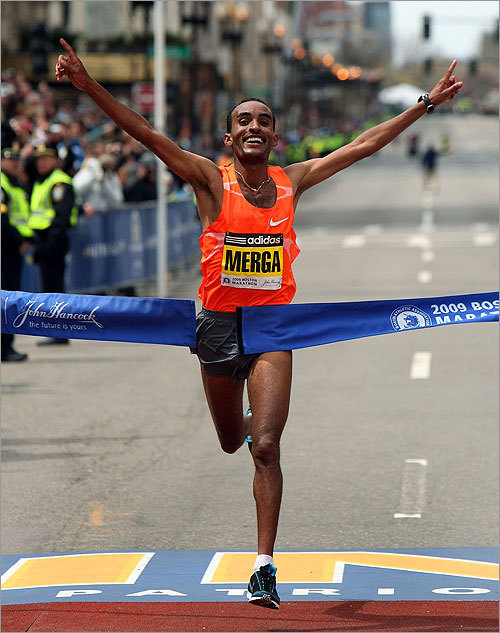
Team In Training IL

Sunday, January 1, 2012

Running and Athletic Walking Form

Image from iRunnerBlog.com
By using proper form for walking you can become more efficient in your stride and confident in your ability to achieve your goals.  The technique will help you safely cover more ground in less time, with less effort, and with greater consistency.

When you practice your technique, break each component down to an individual motion and focus on one at a time.  Eventually it will all come together.  Be patient.  It takes time and practice to have this new form come naturally.  

Heads Up!
Your head should be level, eyes looking forward, and the chin parallel to the ground.  A protruding chin or tilting the head down to look at the ground is a common mistake.  If your head is allowed to tilt forward, excess strain is put on the neck and shoulders and will lead to undue fatigue.  Focus on looking forward to about 12-20 feet in front of you.  If you need to look closer to where you are stepping, lower your eyes, not your whole head.

Arm Swing
Your shoulders should be relaxed, not drawn up towards your ears.  Arms should swing naturally with each step, and should be bent at the elbow at a 90 degree angle.  This is important.  Straight arms during long walks and runs wastes energy and can lead to problems with swelling, tingling, and numbness of the fingers or hands.
Your arms should swing comfortably and naturally at about waist level.  When you are running focus a little more on the front part of the swing.  When you are walking focus on the back swing.  Do not pump your arms, but allow them to swing like a pendulum.  Your hands should be relaxed and loosely closed.  Any excess tension in the arms or hands should be avoided -- it wastes energy.  The elbows should be close to the torso, with the hands going no higher than the center of the chest on the forward swing, or past the back of the hip on the back swing.

Posture
Think about having a nice, straight body position (as opposed to being hunched over) with a slight forward lean. Imagine having a rope tied to your chest pulling you forward and up. Keep your chest out, your head up, and your vision scanning the path approximately 15-20 feet in front of you. The straight body position will keep your muscles relaxed and in balance while opening your lungs for maximum oxygen intake. Remember to keep the slight forward lean as this will help with your foot turnover and allow you to move down the path lightly and efficiently.

Turnover
Turnover is how quickly you step.  Most people, when they try to go faster increase the length of their strides.  This is inefficient, and will waste energy.  It will also set you up for injury as it increases the impact of every stride. We will get more into turnover rate later, but for now practice shortening your stride and taking very quick steps, whether you are walking or running.  Pretend you are walking or running over hot coals and want to get your feet off the ground as quickly as possible.

Thursday, December 29, 2011

How To Read the Sprummer Schedule

Below is YouTube video on how to read the 2012 Sprummer (Spring & Summer) Half & Full Marathon Schedule.

From winter to summer we're training for The Rock & Roll San Diego Half /Full Marathon, Vancouver Half/Marathon, North shore Half Marathon, Illinois Christie Clinic Half/Full Marathon, and the Chicago Shamrock Shuffle. 
For more information on how to join visit the Illinois Team In Training Website


Tuesday, December 27, 2011

Marathon Coaching Tip - Pacing

Learning how to pace yourself is one of the most important things that you can learn.  Finding the correct pace that you should be running or walking for your long trainings will allow you to complete your trainings and give you confidence. Many people, especially when they are first starting out go too fast.  This causes them to have to slow down or not be able to complete the workout the way they planned leading to frustration and discouragement.

For your long trainings you should be training at a conversational pace.  You should not feel like you are sitting on a couch or walking through a mall.  You should feel like you are working but not working so hard that you have to gasp for breath or be unable to talk.  You should be able to have a conversation while you are athletic walking or running.  You should feel that from a breathing or heart rate perspective you can go on forever. If you are panting for breath or cannot talk YOU ARE GOING TOO FAST, no matter how slow you may think you are going you need to bring it down until you can breathe easier!!!

On the perceived exertion scale (CLICK HERE TO READ) this level is about a 6.   If you are familiar with heart rate training zones this level is between 65% and 80% of your maximum heart rate.  If you are having difficulty find your pace, the use of a heart rate monitor can help you to keep your training within the proper zone.  Soon you will know what this zone feels like and be able to train in that zone automatically.  If you would like help to determine your target heart rate and/or use a heart rate monitor to help you with your training ask your coach.

If you are worried that you aren’t going fast enough, don’t.  The focus right now should be on finding this pace.  If you are worried you will never get faster training at this pace, don’t.  There are times during this season where we will be getting your heart rate up and you will be training at a higher intensity where you have difficulty catching your breath.  There is a time and a purpose to this type of training but your long trainings are not it!!!  We will bring this type of training in at the appropriate time.

Also, remember that this is all about YOU!!!!  Your pace is your pace.  You do not have to keep up with anyone else in the group.  If you are training with a friend you might not both be at the same fitness level or pace right now. You may need to split up for training and meet at the end to talk about how great you both did!

We are here to help you to find your appropriate training and event paces.  Talk to us if you are having difficulty “getting in the zone”!

Coach Update for the Week of December 26, 2011

Happy Holidays. Just a reminder, that there is a video tutorial on how to read the summer schedule you can view on YouTube.com. If you just need the training schedule CLICK HERE. Our first training we be NEXT Saturday at Edwardo's Pizza in Skokie. Remember to come in your training gear and bring a change of clothes. 

This week's coaching topic is on Pacing. Keep reading on to learn more.

Midweek Training
As a reminder, every participant should be following Block 1: Week 4 Workouts this week.

Group Training

December 31- No Group Training Scheduled

Saturday Long Distance Training
Shamrock Shuffle Beginning - 1 mile
Shamrock Shuffle Advanced - 2 hills
IL Full & Vancouver Full- 4 miles
IL Half & Vancouver Half- 3 miles
San Diego Full, Half, & North shore Half - 30 minutes.
Pre Fall - 30 minutes

Kickoff Party / First Training - Saturday, January 7, 2011, 10 a.m.
Edwardo's of Skokie
9300 Skokie Blvd.  
Click Here for a link on Google Maps.
FYI Look out for a bright Yellow Chevrolet Colblat with the Plate SDESHOW. It's Mine.

Monday, October 17, 2011

Coach Tip - Life After an Endurance Event

After experiencing the personal satisfaction of completing one's first marathon or half-marathon, many runners and walkers are interested in resuming their training immediately. While completing a marathon or half-marathon is quite exciting and motivating, extreme care must be taken in the weeks following the race regarding the rebuilding mileage of to pre-race levels.
The effects on the muscular-skeletal system are tremendous, as muscles have experienced micro-trauma, a fancy word for very small tears of the muscular tissue that normally occurs as a result of the physical demands of the event. This is a normal occurrence. These tears require adequate time to heal and regenerate. Jumping right into a heavy training schedule will slow down the recovery of muscles and soft-tissue. Even if the micro-trauma damage is minimal, the soft connective tissue and bones of the body are in a vulnerable state immediately following the marathon.
To reduce the possibility of incurring an injury, a prudent approach to the full resumption of training should be taken. Some training resources state that athletes should take a week or so off after an endurance event. Instead, it is recommended to engage in cross-training activities to maintain cardio-vascular fitness while at the same time, allowing the body to rest, recover, and heal. My belief is that you must listen to what your body tells you. If you are experiencing muscular soreness, walking or easy cycling are ideal activities to loosen up the legs the week following the race.
Scheduling Your Next Event
How soon can you begin training for, and participating in your next marathon or half-marathon? The answer to this question depends on several factors. Some of these include, but are not limited to, years of running experience, type/intensity of the training program utilized for the previous race, energy/effort expended during that race, duration/completeness of leg recovery from the previous race, among many other factors.
The central concept to consider is that the body needs adequate time to recover from a marathon. Training for, and competing in another13.1 or  26.2 mile event before one's legs have fully recovered can lead to a variety of overuse injuries. Is it worth the risk? While I don't think that it is, the decision is ultimately yours.
Staying Motivated and Combating Burnout
It's not uncommon for athletes to suffer post-event depression after finishing an endurance event. This is due in part to achieving a goal that took much time and energy to accomplish. Days after the event, runners oftentimes feel a void in their lives. Until you are ready both mentally and physically to set new goals, consider the following strategies to deal with reduced motivation and/or burnout: Run or walk simply for fun, not worrying about following a training schedule; Supplement your running and walking by participating in cross-training activities. Spend more time with family and friends and enjoy some social activities or non-athletic hobbies.
Setting New Goals
When the burnout phase is over, or if you were lucky enough to avoid this period, think about some running goals you'd like to accomplish over the next few months. Keep in mind that these don't necessarily have to center around a marathon. You may wish to improve your 5K time or perhaps, you might be interested in completing a triathlon. See strategies above regarding the setting of new goals.

Tuesday, October 4, 2011

Coach Update for the Week of October 3, 2011


Enjoy when you can, and endure when you must.” –Johann Wolfgang Von Goethe

“Keep your eyes on the stars, and your feet on the ground.” –Theodore Roosevelt

The Chicago Marathon is finally here and Nike only a week away!!!!  Fleet Feet and Half Marathon folks we hope you are keeping up with your walking and running.  Come on out and cheer your TEAM mates on this Sunday.  We know you appreciated the crowds for your events.

Read below for tips for the final days and hours before your event.

Chicago marathoners we wish you a great day.  Remember to take whatever the day gives you and enjoy all that you have accomplished.  The race is the celebration of all of your hard work!

On Wednesday October 4th at 7:00 pm some of the North Team participants will be heading over to TGIFridays in Schaumburg for dinner. Please join us if you can. 

Group Training

Saturday, October 8       8 am
Location:  Busse Woods 0 mile marker
Length of Trainings:
Nike:  60 minutes

Chicago Marathon on Sunday!

Coach Tip - 1 WEEK TO GO and THE FINAL HOURS BEFORE YOUR RACE!

During Week 3 of your taper, things can get ugly. Two weeks ago you trained 20 miles in a single training, but now you won't run or walk this amount all week. And as your mileage plummets, your worries can skyrocket. But take comfort that thousands of other marathoners preparing to race this coming weekend are going through the exact same thing. And take refuge in your final mission: to ensure that your body is sufficiently fueled, hydrated, refreshed, and recovered for the task.
  • Confidence should be the focus of the final week,but you may still experience anxiety. If so, remind yourself that you're physically prepared because you did the necessary training, and you're mentally prepared because you did the necessary trouble-shooting and goal-setting.
  • Try to minimize job, relationship, and travel stresses all week.
  • If you're nervous about the race, try breathing exercises to relax. Breathe in and out as slowly and deeply as possible, letting your belly expand as you inhale. Focus your attention on the breathing and any positive, calming image.
  • If you're too super-charged with energy to sleep, try this relaxation exercise. First tense, then relax your muscles, one at a time, starting with the muscles in your face and working down to your toes.
  • Emphasize carbohydrates more than usual in the last 3 days before the race.  About 60 to 70 percent of your calories should come from carbohydrate sources. Pasta, potatoes, rice, cereals, and fruit are healthy choices, but even sodas and sweets do the job. It all turns into muscle glycogen.
  • Wash all those carbs down with fluids so your energy and water levels are high on race morning. Alcoholic beverages don't count toward your fluid totals, however, and you'll need to make up for their diuretic effect by drinking extra fluids. You know you're adequately hydrated if your urine is clear or pale yellow in color.
  • Don't restrict the salt in your diet. Low salt intake combined with excessive hydration can lead to hyponatremia, a rare but dangerous condition that can afflict marathoners. Drinking sports drinks and snacking on salted popcorn and pretzels will help keep your sodium levels up.
  • Don't look at the scale. Because of your fully stocked fluid and fuel stores you're likely to gain a couple pounds this week. But it's worth the weight. Having your body's energy reserves at full capacity will do more for your race than weighing a little less--and you'll lose those pounds by the finish line anyway.

And Don't Forget
  • Don't do anything tiring. Let the grass grow. Let the kids take out the garbage. Let the dog walk himself.
  • Don't try anything new. No new foods, drinks, or sports.
  • Don't cross-train, hike, or bike.
  • Don't get a sports massage unless it's part of your routine. You may feel bruised a couple days afterward if you're not accustomed to it.
  • Stay off your feet and catch up on movies, books, and sleep. If you go to the pre-race expo, don't stay long.
  • Remember: During this final week, you can't under-do. You can only overdo. 

The Final Hours
  • Feeling calm, confident, and in control is your mission on race morning. Here's how to come by the three Cs:
  • Be sure your race outfit, shoes, timing chip, number, bag, and map to the start are set out the night before, so a treasure hunt isn't required in the morning.
  • Eat a light, easily-digestible meal, such as oatmeal or white toast and a banana, at least 2 hours before the start. Make sure you've eaten these foods before a few training runs with no adverse effects.
  • Drink 8 to 16 ounces of sports drink 60 to 90 minutes before the race.
  • Arrive at the start about an hour early, so you won't have to rush.
  • Joke around with friends or fellow runners before the race to lighten your mood.
  • About 25 minutes before the start, do some walking, slow jogging, then a few 50-meter pickups at race pace. Visit the portajohn one last time. Mentally review your race plan.
  • Position yourself appropriately at the start according to your projected pace, and remind yourself to start easy! You'll be glad you did when late in the race you're able to pass all those runners who started too fast.